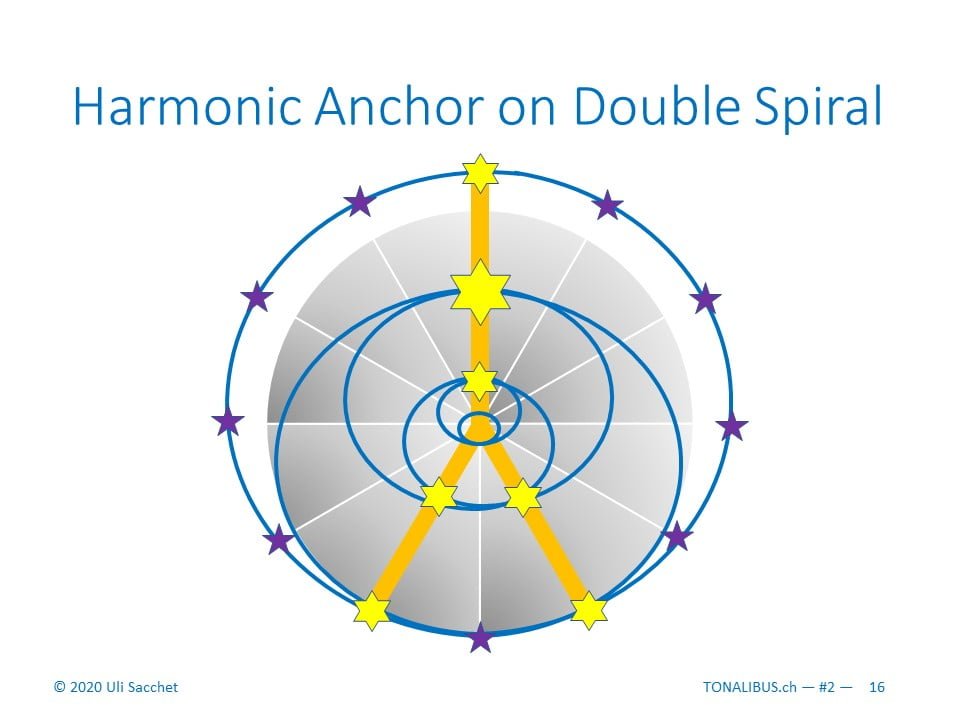
The tonality of the moment is PentaVibhas, a Reach tonality derivative or reduction. It consist of the fundamental, the minor second, major third, quint, and minor sixth (1-2-5-8-9-1). PentaVibhas is a derivative pentatonality that has recently emerged in Tonalibus improvisations and the recordings “Another day breaks” and “Vibhas dawn“. The pitch distribution of this derivative pentatonality is equivalent to the Indian Raag Vibhas / Bibhas (as you can see in the Tonalibus Raagas correlations tables in the Fidibus shop). For derivative tonalities there are no further details in the Tonalibus catalogue. PentaVibhas corresponds to ReachMin (Phrygian dominant) or ReachBal (Gypsy major) with no quart and no seventh, or to ReachNaMin or ReachNaBal with no tritone and no seventh.
Tonalibus PentaVibhas – 2025-04 – 1
Tonalibus PentaVibhas – 2025-04 – 2
Tonalibus PentaVibhas – 2025-04 – 3
You may enjoy a sound sample or tonality loop as sound mantra for contemplation or meditation. This can help with upliftment, purification, and focusing. Or it could simply be used as soothing background sound for relaxation and regeneration. If you care to hum, chant, or sing along, you could use a spiritually charged syllable like Ōṃ / Aum ॐ, or HU, or another mantra syllable that suits you.
Emptiness. Nothing to say. Just sweet silence. Stillness and calm. Finally at peace. With room for all.
Still, here we are. Words, thoughts. Being in this body. Living in this world. While there’s breath. In and out, in duality.
Growing and unfolding. In body, mind, and spirit. Cruising along conscious. More or less alert and aware. Then slowing and shrinking. Fading away in old age?
When the body declines. Spirit can keep soaring. With new insights ever. In silence and calm. Not much to say. In emptiness. All free. Now.
Who looks in the mirror — at the movies or in life
“At some moments there are also gaps in the action; the show gets a bit slow, even boring. We might shift in our seats, notice the people eating popcorn around us, remember we’re in a movie. In the same way we can notice that there are gaps between our thoughts, gaps in the whole sense of our self. Instead of being lost in ideas and the problems in front of us, creating the whole drama of ourself, there are moments when we sense the space around our experience, let go, and relax. ‘These gaps … are extremely good news.’ They remind us that we can always rest in awareness, that freedom is always possible.”
“Awareness has no shape or color. It is beyond presence or absence, coming or going. Instead there is only a clear space of knowing, of consciousness, which is empty and yet cognizant at the same time.”
“When we learn to rest in awareness, there’s both caring and silence, There is listening for what’s the next thing to do and awareness of all that’s happening, a big space and a connected feeling of love. When there is enough space, our whole being can both apprehend the situation and be at ease. We see the dance of life, we dance beautifully, yet we’re not caught in it. In any situation, we can open up, relax, and return to the sky-like nature of consciousness.”
— The Wise Heart — Jack Kornfield — pp. 44-47
Emptiness fulfilled
Pear tree bloom, where Tonalibus found its home — April 2025 — near Bern, Switzerland
This spring 2025 Tonalibus update reiterates the coming May 1, 2025 release of the new triple album “Tonalibus O, P & Q”. Then it highlights new Tonalibus recordings in Playlist R and Sounds. It introduces the derivative tonality PentaVibhas. Further, it refers to the Spotify sounds collections “This is Ulrico” and “Ulrico Radio”. Finally, this update closes with a Spiritualibus blog quote.
May 1 release of the album “Tonalibus O, P & Q”
The new triple album “Tonalibus O, P & Q” appears globally on many music platforms on May 1, 2025 — Spotify, YouTube Music, Apple Music, Tidal, Deezer, Amazon Music, and many more. It covers the themes: “Balance of life and love“, “Discovering new horizons“, and “Coming home to oneself“. It offers 23 meditative improvisations by Ulrico (two with Christina Braun, voice) in thee hours of uplifting music, at times with a touch of blues.More info: Tonalibus O, P & Q — Album.
The first piece on the new triple album “Tonalibus O, P & Q” is: “गरुड़ Garuḍa” — puja for the celestial hawk— Mixolydian on G 390 Hz (rel. A 438 Hz) — harmonium, gong, fujara, lap slide guitar — 10:01
Spring 2025 Tonalibus Playlist R and Sounds update
Playlist R entitled “Waves of silent peace” already offers six pieces in 43½ minutes of recordings, the newest are: — “Trust the boat” — on the high seas — “Permanent impermanence” — heart remediation — “Harmonics of the heart” — hear the overtones? — “Vibhas dawn” — daybreak raag (below)
PentaVibhas (1-2-5-8-9-1) is a derivative pentatonality that recently emerged in Tonalibus improvisations (as in the recording “Vibhas dawn” above). It is equivalent to the Indian raag Vibhas / Bibhas listed in the Tonalibus Raagas correlations tables in the Fidibus shop.
Concepts, basics, or harmony
The Tonalibus website main menu option “Concepts” recently became streamlined to “Harmony” to clearly express its focus and essence. The newly designed page “Harmony” offers eight “Visual harmony basics” and the “Harmony basics presentations”. The basics “Five-cours series” became the “Course preso series” unchanged with Harmonic and Tonality Fundamentals, enabling potential expansion to further course modules.
Ulrico on Spotify editorial and algorythmic playlists
Tonalibus recordings are available on many internet platforms. Spotify seems to be the most significant and generated “This is Ulrico. The essential tracks, all in one playlist” with 32 Tonalibus pieces (3 hr 19 min), as well as “Ulrico Radio” with 50 pieces (about 3 hr) including up to 10 Tonalibus recordings intermixed with pieces of other somewhat compatibly sounding musicians.
First lines of the March 27 Spiritualibus blog post “Sound of silence“
Sound of silence to be heard and seen one for all and all for one he or she who hears will see the light and the love in all life . . .
Wrapping and contents what is it that is as it is in the chain of relations conditioned by duality on the outside it appears the inside hidden mostly it seems as it appears to one perception triggers thought concepts one may find to wrap what is inside realize what is real establishing basics a foundation for one to stand impermanence that all just wraps around contents, preferably essence concepts and basics may point to as some most crucial questions arise answering themselves in patterns of the harmony that’s observed in sound, light, life, and love renouncing self possession letting go of illusions about self recognize blessings in every loss as divine harmony carries on all that which just is as it is to unwrap it and be free beyond basic concepts the contents’ harmony wisdom of loving hearts in patience and gratitude may you and I and all be free!
“Harmonics of the heart” — can you hear the overtones?
ॐ Om/Aum chant on C# (69 Hz) — single note chanting bass voices — 9:13
Contents can be mostly freed of wrapping
“This holy wisdom is whispered by the Tibetans in the ear of one who is dying. ‘Remember the clear light, the pure clear light from which everything in the universe comes, to which everything returns, the original nature… It is your own true nature; it is home.’
“It is sung as the prayer of oneness in Judaism, it is worshiped as the Holy Spirit of Christian love, it is celebrated as the eternal Brahman by the Hindus, and it is the essence of the Tao.
“If you don’t realize the source you stumble in confusion and sorrow. When you realize where you come from you naturally become tolerant, disinterested, amused, kindhearted as a grandmother, dignified as a king. Immersed in the wonder of the Tao you can deal with whatever life brings, and then, when death comes, you are ready. (translated by Stephen Mitchell)
“When we embody this truth, our life becomes a blessing. Compassion, understanding, a joyful freedom touch all we meet. A radiance of love pushes out of us… Without imitation, we become just who we are. Our being is at ease; our heart opens. Joy and freedom of spirit fill our days.”
— After the Ecstasy, the Laundry, Jack Kornfield, p. 296-297
No wrapping, just content contents
Warm spring sun rays melt snow and ice into the brook — March 2025 — Tschingel, Kiental, Switzerland
Sound of silence to be heard and seen one for all and all for one he or she who hears will see the light and the love in all life a passing show on Earth all changing evolving in oh so many ways just as it is.
She or he who sees can hear it clearly the sound of silence in her or his heart while ‘his or hers’ dissolves as an illusion for in the end possession belongs to nature as he and she and all are learning to see.
One who hears and sees will value high the qualities and divinity of all others while most who don’t will look down upon the others as inferior beings to be controlled by power plays in megalomaniac possession.
How far does this have to go to dissolve itself eventually in all the space given to dry up as one hears the sound of silence sees and can step out of the way let it flow freely and resolve the way it is no matter what illusion and impermanence as one may see and hear the sound of silence to be heard and seen one for all and all for one he or she who hears will see the light and the love in all life.
“Permanent impermanence” — heart remediation blues
PentaBlue on D (rel. A 438.2 Hz) — 8-string guitar, crotales, nepali cymbals, tanpura — 7:43
The way it is — a closer look
“I was standing out on this evening and looking at the dusk, at the trees, … just contemplating … that trees are conscious. There is a certain level of consciousness in all life, in the fact that there is receptivity to the environment; and trees are very receptive to the environment they are in. One begins to change the perception of mind to one of a consciousness that pervades everything. Then it’s not just a human mind, there’s something more to it. But in Buddhism it is never named, you never try to form a concept about it. Instead you contemplate the totality, the whole sensitivity, the sensory realm and what it is really about. And that we have to contemplate from our own ability to be conscious and to feel but not see it in terms of ‘me’ and ‘mine’ — …”
Do you hear the sound of silence?
“With the sound of silence, some people hear fluctuations of sound or a continuous background of sound. So you can contemplate it, you notice that — can you notice it…? You’re using this sound of silence as something to remember to turn to and notice — because it’s always present here and now. And there’s that which notices it.
“There is the desire of the mind to call it something, to have a name for it, have it listed as some kind of attainment or project something on to it. Notice that, the tendency of wanting to make it into something. Somebody said it’s probably just the sound of your blood circulating in your ears, somebody else called it ‘the cosmic sound’, ‘the bridge to the Divine’. That sounds nicer than ‘the blood in your ears’. It might be the sound of the Cosmos or it might be that you’ve got an ear disease. But it doesn’t have to be anything; it’s what it is, it’s ‘as that’. Whatever it is, it can be used as reflection because when you’re with that, there is no sense of self, there is mindfulness, there is the ability to reflect.
“So it is more like a straight edge that you can go to, to keep you from going wobbly. It is something you can use to compose yourself in daily life…”
Do you listen to the sound of silence?
“The significant offering of the Buddhist teaching lies in what we call non-dualism. It’s the ‘neither-nor’ approach to philosophical questions. … “Now what does that do, as a practical experience, when you let things go and they cease? What’s left, what’s the remainder? … “When the perception of self ceases and all the doctrines, all the inspired teaching, all the wise sayings cease, there is still the knower of the cessation. And that leaves us with a blank mind. What is there to grasp?”
“Open to the silence and contemplate it, learning from it rather than running away from it to look for a warm mother or a safe father. “Then one way you can describe this Holy Life is a growing up of an individual being to that maturity where we no longer linger in the warmth of adolescence or childhood, or in the pleasures of the world.”
The shining through of the divine
“In our lives as separate beings, we relate to things. As individual beings, we have relationship to things, we have to meet and contact and react or respond to objects all the time for the rest of our lives. On the physical level, we have to respond to each other’s presence in some way, either ignoring or embracing or paying respects or cursing. In relationship, when there’s no self, then there is this divinity that manifests. So you can see that the human form is a form for the divine.”
“Five billion human beings who can manifest the divine in their daily lives, through metta, karuna, mudita, upekkha. That doesn’t sound so bad, does it? Sounds rather nice. “But five billion human beings manifesting greed, hatred and delusion is a pretty grim picture. Yet we don’t have the right to comment on them: this one here, this is what we have, this is what we can work on. Don’t worry about the others. This one here is what you can actually develop through reflection and through meditation.”
— The Way It Is, Ajahn Sumedho, pp. 102-103, 109, 115, 117, 157, 165
Mostly silent songs of the trees
Rising sun behind silent trees casting their shadows — March 2025 — Chanhassen, Minnesota